What Exactly Is Cryptocurrency?
TradingKey - Cryptocurrencies, also known as virtual currencies, may seem similar to fiat currencies such as the US dollar and the euro, but there is a fundamental difference between the two: fiat currencies are issued by governments or central banks, whereas cryptocurrencies are issued by individuals or institutions leveraging blockchain technology. In addition, while cryptocurrencies and stocks appear vastly different, from a financing perspective, they are both fundraising instruments with no essential difference.
Therefore, cryptocurrency can be viewed as an emerging fundraising instrument issued leveraging blockchain technology. Because it utilizes emerging technology, it possesses characteristics that set it apart from traditional financial assets like fiat currencies and stocks, such as decentralization, immutability, and peer-to-peer transfers and settlements. Simply put, the shortcomings of traditional finance are precisely transformed into advantages by cryptocurrencies, most notably through the elimination of intermediaries, which not only removes cumbersome intermediate steps to accelerate financial operations, but also saves substantial unnecessary costs.
What Cryptocurrencies Are There?
The number of cryptocurrencies is not fixed; new cryptocurrencies are created and go to zero every day, and a large number of on-chain tokens are not included in statistics, which also means that statistical data across different data platforms varies significantly. According to CoinMarketCap data, there are currently over 8,000 cryptocurrencies.
Based on technical architecture and application scenarios, they are mainly divided into four major categories: First, public chain coins, including Bitcoin (BTC), Ethereum (ETH), Solana (SOL), TRON (TRX), etc.; second, platform tokens, including Binance Coin (BNB), OKB, etc.; third, meme coins, including Dogecoin (DOGE), Shiba Inu (SHIB), PEPE, etc.; fourth, utility tokens, which can be further subdivided according to their use cases into stablecoins (USDT, USDC, DAI), DeFi tokens (UNI, AAVE, HYPE), etc. It should be noted that results may vary depending on the classification criteria or basis, and a single token may possess multiple attributes—for example, BNB is both a public chain coin and a platform token.
Which Cryptocurrencies Are Suitable for Beginners?
For beginners entering cryptocurrency, the core principle is to avoid high risk and high leverage while focusing on assets with high market capitalization and strong consensus. Therefore, one can consider cryptocurrencies ranked in the top ten by market capitalization. Excluding stablecoins USDT and USDC, which only serve as a store of value and do not offer asset growth potential, there are ultimately only eight.
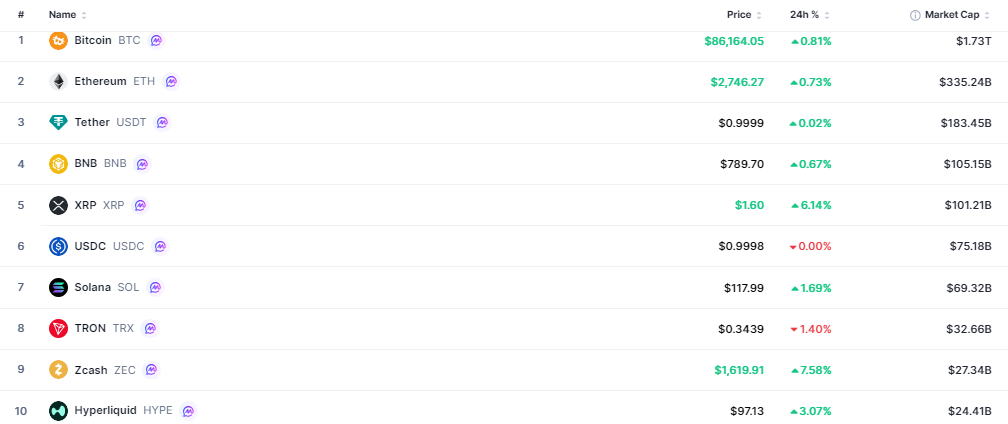 Top 10 Cryptocurrencies by Market Cap, Source: CoinMarketCap
If eight options still feel like too many, you can narrow them down to three: Bitcoin, Ethereum, and BNB. Not only do they have large market capitalizations, but they are also leaders in their respective sectors with solid market consensus, as follows:
Cryptocurrency | Core Positioning | Reasons for Suitability |
Bitcoin | Digital Gold | • Ranked #1 by market cap, strongest consensus • Primary allocation target for institutional investors and spot ETFs • Relatively strongest resilience to volatility |
Ether | Blockchain Application Infrastructure | • Largest decentralized application (DeFi, NFT, Layer 2) ecosystem • Features real gas fee demand and burn mechanism • Ranked #1 in technological innovation and developer activity |
BNB | High-Quality Exchange Token | • Backed by the world's largest exchange ecosystem • Usable for trading fee discounts and participation in Launchpool token farming • Periodic burn mechanism enhances scarcity |
Cryptocurrency Investment Strategies for Beginners
The cryptocurrency market is highly volatile. For beginners, the core investment principles are risk management and establishing discipline, covering aspects such as capital allocation, trading strategies, and exchange selection.
Crypto investments should be controlled within 10% of an individual's total investable assets, with Bitcoin accounting for more than half, Ethereum 30%, and BNB 20%. Of course, if you have a higher risk tolerance, you can adjust the allocation ratio based on your situation, such as 40% BTC + 30% ETH + 30% BNB.
The most recommended entry method for beginners is dollar-cost averaging (DCA), investing a fixed amount weekly or monthly regardless of price fluctuations. This avoids buying at market peaks all at once and mitigates the psychological stress of a sharp drop; moreover, automated deductions reduce the pressure of chart-watching and emotional decision-making.
In addition, be sure to choose compliant leading exchanges that provide proof of reserves, such as Coinbase, Binance, OKX, etc. If you hold a large amount of assets, it is recommended to learn how to use cold wallets to self-custody private keys or recovery phrases. These must be written down on paper and kept offline; never screenshot them to store on cloud drives or send them to anyone.
Conclusion
Cryptocurrencies are emerging decentralized financing tools based on blockchain technology. While a vast array of tokens has already emerged in the crypto market, beginners should focus on high-market-cap assets with strong consensus, prioritizing the top three leaders: Bitcoin, Ethereum, and BNB. It is recommended to keep total capital allocation within 10%, invest disciplinedly through dollar-cost averaging, and use compliant exchanges and cold wallets to ensure asset security.
Find out more