NZD/USD (NZDUSD) is down 0.54% at Oct 1 05:55(ET), now at $0.56014, with a 7-day down of 1.04%.
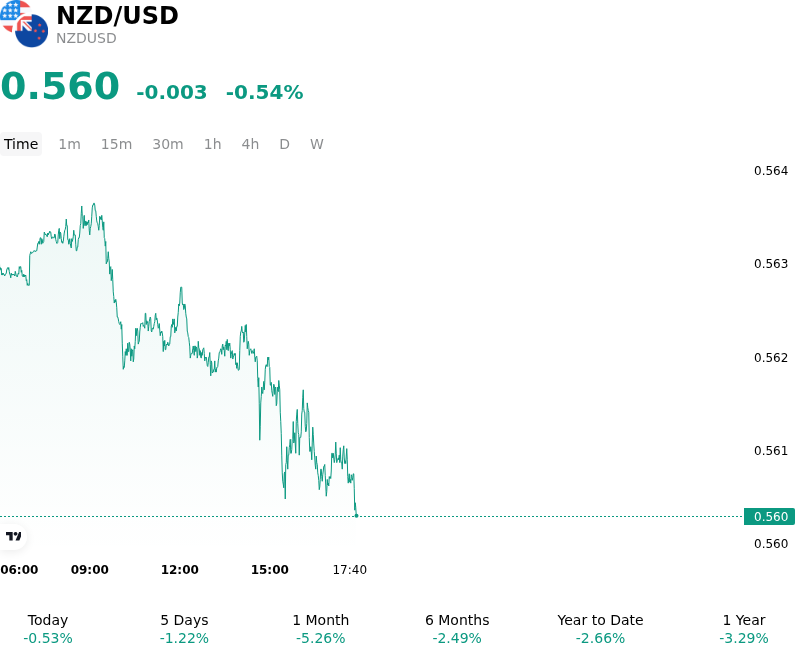
What is driving NZD/USD (NZDUSD)’s stock price down today?
The retreat in NZDUSD was primarily driven by persistent strength in the U.S. Dollar, anchored by elevated U.S. Treasury yields and firm market expectations for a prolonged period of restrictive Federal Reserve monetary policy. Following the Federal Reserve's recent policy rate hike, widening short-term yield differentials between the United States and New Zealand continued to favor the greenback, drawing institutional capital into dollar-denominated fixed-income assets. Although market participants continue to monitor incoming U.S. inflation and employment metrics, resilient economic activity data and firm bond yields have reinforced the U.S. Dollar's yield advantage over high-beta currencies.
On the domestic front, the New Zealand Dollar faced ongoing headwinds from a weak macroeconomic backdrop and emerging domestic political uncertainty. Recent New Zealand economic indicators have pointed to sluggish household spending, a cooling labor market, and subdued consumer confidence, constraining the local economic outlook. Furthermore, tight political polling ahead of the upcoming election introduced elevated policy uncertainty, prompting institutional investors to demand a higher risk premium on New Zealand assets and weighing on sentiment toward the Kiwi dollar.
Global macro conditions and broader risk appetite also reinforced the currency pair's downward trajectory. Heightened geopolitical friction in the Middle East and energy-driven inflation risks continued to cloud global growth prospects, sparking cautious, risk-averse sentiment across international equity and credit markets. As a growth-sensitive commodity currency, the New Zealand Dollar underperformed relative to the safe-haven U.S. Dollar in this fragile market environment. The movement was further amplified by technical factors as NZDUSD broke through key short-term support levels, accelerating momentum-based systematic selling.
Looking ahead, the medium-term outlook for NZDUSD will depend on upcoming U.S. labor market and inflation releases to gauge the future trajectory of Fed rate expectations, alongside evolving political developments and domestic growth signals in New Zealand. Until global risk sentiment stabilizes or U.S. yields pull back, the pair remains structurally vulnerable to wider interest-rate differentials and persistent macro headwinds.
Technical Analysis of NZD/USD (NZDUSD)
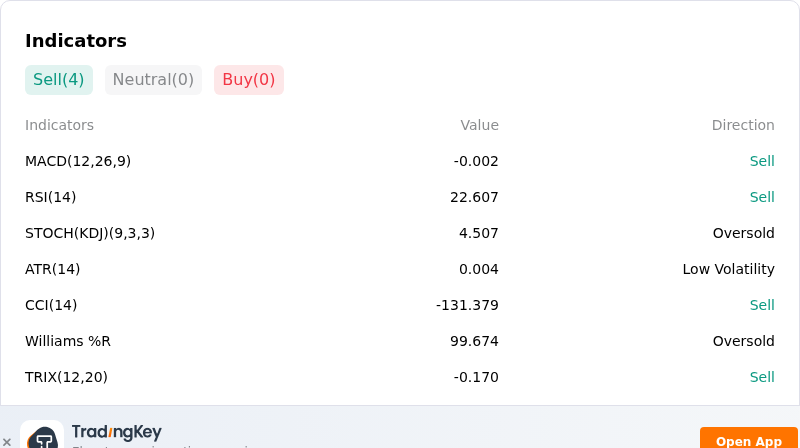
Technically, NZD/USD (NZDUSD) shows a MACD (12,26,9) value of -0.002, indicating a sell signal. The RSI at 22.607 suggests sell condition and the Williams %R at 99.674 suggests oversold condition. Please monitor closely.
More details about NZD/USD (NZDUSD)
Recent Events and Risks:
- Widening Yield Differentials and Fed Expectations: Elevated US Treasury yields and lingering expectations for tight Federal Reserve monetary policy continue to favor the greenback over the New Zealand dollar, as US fixed-income assets offer a sustained interest-rate advantage over Kiwi-denominated yield products.
- Geopolitical Risk Aversion and Safe-Haven USD Flows: Escalating Middle East geopolitical friction and fears of maritime trade disruptions have dampened global risk appetite, severely curtailing capital allocation into high-beta commodity currencies like the New Zealand dollar in favor of safe-haven greenback holdings.
- Energy Price Shock and Domestic Terms-of-Trade Drag: Spiking global crude oil prices driven by supply chain vulnerabilities impose severe imported inflation on New Zealand as a net energy importer, threatening to depress domestic economic growth and consumer discretionary spending.
- Technical Support Failure and Intraday Momentum: Persistent trading below key short-term exponential moving averages and the recent breach of key support near 0.5640 have triggered systematic trend-following sell orders, leaving NZD/USD vulnerable to accelerated downside momentum.
Find out more